
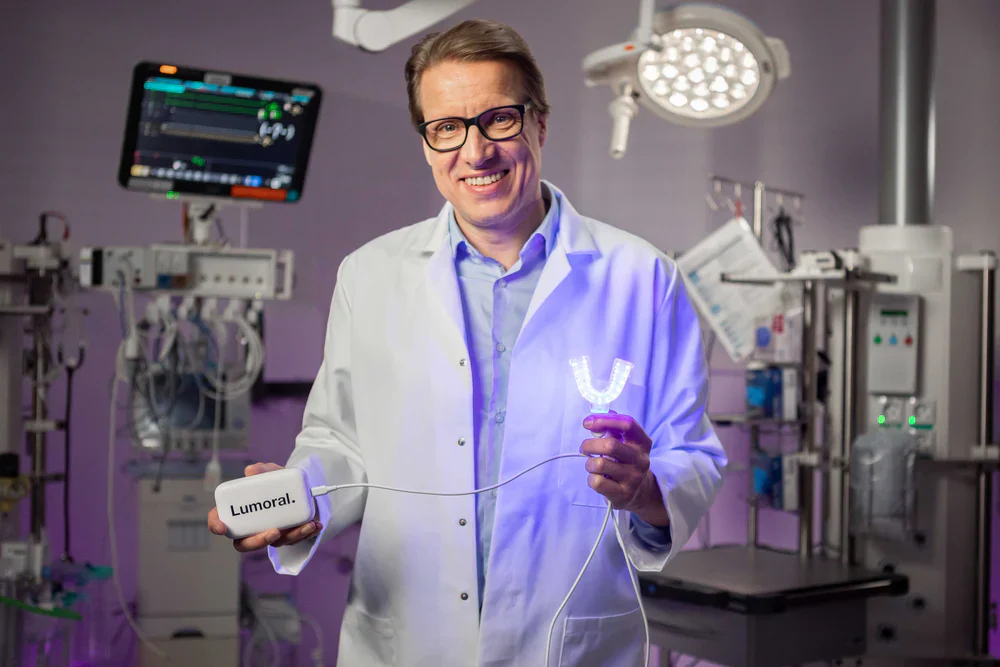
Heart Surgeon Dr. Tommi Pätilä grew increasingly concerned by the recurring presence of oral bacteria in patients’ hearts during surgery. A clear link emerged: poor oral hygiene, particularly bleeding gums from brushing or flossing was enabling bacteria to travel through the bloodstream. It was time to take action.
Traditional toothbrushes and mouthwashes simply aren’t enough for the tech-savvy individual who demands precision in their health optimisation routine. Studies show that even the most powerful electric toothbrush removes only about 65% of harmful bacteria, leaving substantial residual plaque that conventional methods cannot address. This gap between mechanical cleaning and true bacterial elimination has sparked a revolution in light therapy for oral health, bringing professional-grade photodynamic therapy into the home environment. Lumoral’s breakthrough technology represents the convergence of Finnish medical innovation and biohacker-friendly design, offering a CE-marked solution that targets oral bacteria with unprecedented precision.
Why traditional oral care fails biohackers and tech enthusiasts
Mechanical plaque removal through brushing and flossing operates on a fundamentally limited principle. These methods can only address visible biofilm accumulation, yet the most problematic bacterial colonies exist at microscopic levels that remain untouched by conventional approaches. For medical technology enthusiasts who understand the complexity of the oral microbiome, this represents a significant gap in preventive care protocols.
Traditional antiseptic mouthwashes create their own problems through broad-spectrum bacterial elimination. These solutions indiscriminately target both harmful pathogens and beneficial oral flora, disrupting the delicate microbial balance that sophisticated health optimisers work to maintain. The result is temporary bacterial reduction followed by potential recolonisation with less favourable species.
However, the most significant limitation lies in the inability of conventional methods to penetrate established biofilms. These bacterial communities develop protective matrices that shield pathogenic organisms from mechanical disruption and chemical intervention. Tech enthusiasts seeking comprehensive solutions recognise that addressing biofilm architecture requires targeted approaches beyond traditional cleaning methods.
How light therapy for oral health transforms bacterial elimination
Photodynamic therapy represents a paradigm shift from mechanical disruption to photochemical bacterial inactivation. The process utilises dual-wavelength LED technology, combining 405nm blue light for direct antibacterial action with 810nm near-infrared light for tissue support and photobiomodulation. This sophisticated approach enables selective bacterial targeting without the collateral damage associated with broad-spectrum antimicrobials.
The photochemical mechanism begins when light-sensitive compounds bind specifically to bacterial cell walls and biofilm matrices. Upon activation with precise wavelengths, these photosensitisers generate reactive oxygen species that penetrate bacterial defences and cause cellular damage through oxidative stress. The process proves particularly effective against Streptococcus mutans and periodontal pathogens that resist conventional treatments.
Near-infrared photobiomodulation simultaneously supports gingival tissue health through enhanced cellular metabolism and improved circulation. This dual-action approach addresses both bacterial elimination and tissue recovery, creating optimal conditions for long-term oral health maintenance. The synergistic effect delivers results that neither mechanical cleaning nor chemical intervention can achieve independently.
The Finnish breakthrough: Lumoral’s CE-marked innovation advantage
Koite Health Oy’s development team combines medical expertise with engineering precision, led by physician Tommi Pätilä and supported by academic collaboration from Helsinki University and the Karolinska Institute. This multidisciplinary approach ensures that innovation meets rigorous clinical validation standards required for CE marking and professional acceptance.
The HOPE-CP study demonstrated significant improvements in bleeding on probing, with 54% of Lumoral users achieving healthy gingival inflammation levels (BOP less than 10%). Two-thirds of participants experienced at least 50% reduction in deep periodontal pockets compared to baseline, results significantly superior to control groups using conventional care alone.
Clinical validation extends beyond periodontal applications, with randomised controlled trials demonstrating efficacy in peri-implantitis treatment and elderly care populations. These studies confirm that light-activated therapy delivers measurable improvements in plaque reduction, gingival bleeding, and pocket depth reduction across diverse patient populations.
What makes photodynamic therapy essential for advanced oral care
Indocyanine green (ICG) integration represents the technical cornerstone of effective photodynamic therapy. This FDA-approved photosensitiser, used in medicine since the 1950s, selectively binds to plaque biofilms while leaving beneficial oral bacteria largely undisturbed. The specificity of this targeting mechanism addresses the primary limitation of conventional antimicrobial approaches.
The treatment protocol optimises convenience without compromising efficacy. The 60-second Lumorinse application ensures adequate photosensitiser distribution and biofilm penetration, while the 10-minute LED activation period provides sufficient energy for complete photochemical bacterial inactivation. This timing represents the optimal balance between therapeutic effect and practical implementation.
Therefore, the localised antibacterial effect eliminates up to 99.998% of harmful plaque bacteria without systemic absorption or disruption of distant microbial communities. This precision targeting enables frequent use without the resistance development or microbiome disruption associated with traditional antimicrobials, making it the ideal oral hygiene device for deep cleaning applications.
Implementation challenges every biohacker should consider
Device cost represents the primary barrier for early adopters, particularly when compared to conventional oral care products. The initial investment in LED technology and ongoing photosensitiser supplies requires budget allocation that extends beyond traditional dental care expenses. However, the cost must be evaluated against potential savings from reduced professional interventions and improved long-term outcomes.
Treatment frequency protocols demand consistent implementation for optimal results. Healthy individuals require application approximately every four days, while those with existing periodontal issues may need daily use during initial treatment phases. This commitment level exceeds conventional brushing routines and requires integration planning for travel and schedule disruptions.
Yet the learning curve for optimal technique remains minimal compared to other medical devices. The mouthpiece design accommodates various dental arch configurations, and the automated 10-minute cycle eliminates timing concerns. Most users adapt to the treatment sensation within the initial applications, though some experience temporary warmth during the photodynamic activation process.
As a result, successful implementation depends on realistic expectation setting regarding timeline and commitment. While improvements in gingival health become apparent within weeks, optimal bacterial load reduction and biofilm disruption require consistent long-term use. Tech enthusiasts seeking how to prevent cavities naturally will find this approach highly effective when integrated systematically into existing health optimisation protocols.

