
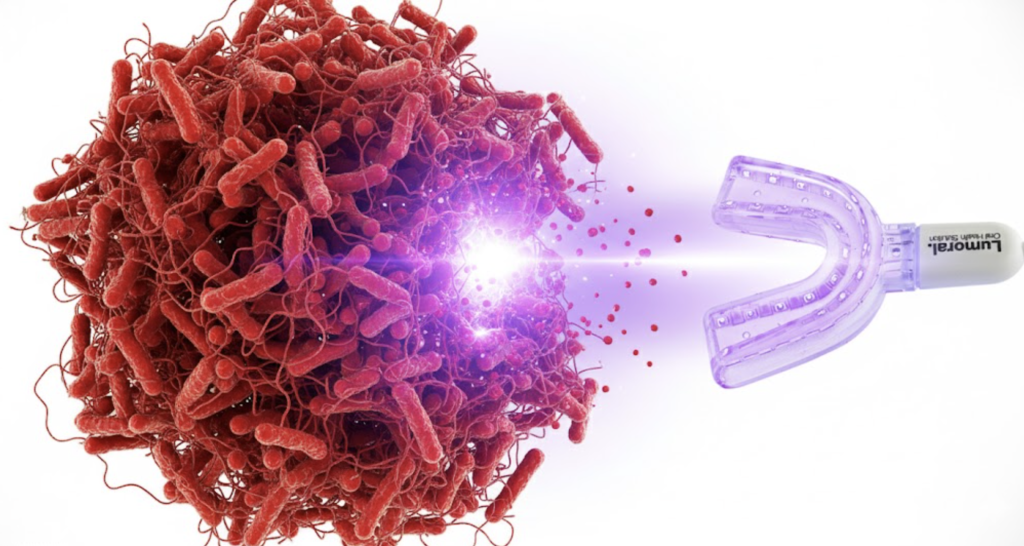
Every morning, millions of people worldwide follow the same oral hygiene routine: brush, floss, rinse, and assume their mouths are clean. News flash – its not enough! Even the most diligent brushing with the most powerful electric toothbrush leaves behind what dental professionals call residual plaque, microscopic bacterial colonies that continue to thrive despite our best efforts with traditional oral hygiene products.
This persistent bacterial growth progresses silently until complications arise. The limitations of conventional approaches have prompted researchers to explore innovative solutions, including photodynamic therapy – a light-activated treatment that targets oral bacteria while preserving beneficial microflora. This technology is now available for consumers for home dental care, and the company behind it, Koite Health, believes it is the biggest revolution in home dental care, since the electric toothbrush.
Understanding why standard oral hygiene methods fall short requires examining the fundamental nature of bacterial biofilms and how emerging technologies like photodynamic therapy address these limitations more effectively than traditional approaches.
An ICG rinse binds to plaque on teeth and gums and is then treated for ten minutes with dual light therapy. This technology heals gums by removing plaque, and thus infection, while maintaining oral flora. Lumoral is on a mission to significantly improve oral health globally!
What makes traditional oral hygiene insufficient
The primary challenge with conventional oral hygiene products lies in their inability to effectively penetrate and disrupt mature bacterial biofilms. Think of it as a protection they bacteria makes for itself, a force field of sorts. These complex microbial communities form protective matrices that shield bacteria from mechanical cleaning and chemical antimicrobials. While brushing removes visible plaque and food debris, it cannot reach bacteria embedded in deep periodontal pockets or those protected within biofilm structures. Periodontal pockets are basically places deep within the gums where they hide.
Traditional mouthwashes present their own limitations. Broad-spectrum antimicrobial rinses like chlorhexidine destroy both harmful and beneficial bacteria indiscriminately, disrupting the oral microbiome’s natural balance. You want to get rid of plaque on teeth and gums, but you also want to keep a good bacterial balance in the mouth overall. Moreover, with long-term use, these products can impair taste sensation and cause tooth discoloration. Most concerning, bacteria cannot develop targeted resistance to specific treatments, making conventional approaches less effective over time.
Flossing, though essential for interdental cleaning, primarily addresses mechanical debris removal but offers limited antimicrobial action against established biofilms. The combination of these traditional methods, while beneficial, leaves significant gaps in bacterial control – particularly in areas where mechanical access is limited or where biofilms have matured beyond the reach of conventional cleaning.
How photodynamic therapy targets oral bacteria differently: the revolution is here!
Photodynamic therapy represents a fundamentally different approach to bacterial control, utilizing light-activated antimicrobial treatment to achieve biofilm disription. The process involves two key components: a photosensitizing agent and specific wavelengths of light, 405nm blue light togther with near infrared red-light, which creates a localized antibacterial effect.
When the photosensitizer encounters bacterial cells, it binds to harmful plaque bacteria while leaving beneficial oral flora largely unaffected. Upon activation by the appropriate light wavelength, the photosensitizer generates reactive oxygen species that destroy bacterial cell walls and disrupt biofilm structures from within. In addition, during the treatment heat is created when the light activates the substance, resulting in a very effective thermal effect. This mechanism proves particularly effective because it targets bacteria at the microscopic level, reaching areas that mechanical cleaning cannot access, even in deep gum pockets.
The exceptional antibacterial effectiveness of photodynamic therapy comes from its ability to target residual plaque with microscopic precision, maintaining healthy bacterial balance while eliminating harmful microorganisms.
Unlike traditional antimicrobials that work through chemical action alone, photodynamic therapy combines photochemical bacterial inactivation with tissue support mechanisms. The dual-light approach often incorporates near-infrared wavelengths alongside blue light, providing both antimicrobial action and photobiomodulation to support gingival tissue health. This targeted approach addresses the root cause of bad breath and oral health issues more effectively than conventional methods.
Why clinical evidence supports photodynamic advantages
Controlled clinical studies suggest measurable improvements in key oral health indicators when photodynamic therapy is added to conventional periodontal treatment. Studies suggest significant reductions in bleeding on probing – a critical marker of gum inflammation – along with decreased formation of deep periodontal pockets that harbor harmful bacteria.
The clinical advantages extend beyond immediate bacterial reduction. Studies indicate that photodynamic therapy slows plaque formation over time, leading to sustained improvements in overall oral health. This sustained effect occurs because the treatment disrupts biofilm architecture at the molecular level, making it more difficult for bacteria to re-establish mature colonies.
Which oral health conditions benefit most from light therapy
Gingivitis management represents one of the most promising applications for photodynamic therapy. The treatment’s ability to reduce gum inflammation while supporting tissue healing makes it particularly effective for addressing early-stage gum disease before it progresses to more serious periodontal conditions.
Patients with periodontitis benefit from photodynamic therapy’s capacity to reach bacteria in deep periodontal pockets where conventional cleaning proves insufficient. The light-activated treatment can penetrate these hard-to-reach areas, providing antimicrobial action that complements scaling and root planing procedures.
Plaque control applications extend to caries prevention, as the treatment targets Streptococcus mutans and other bacteria responsible for tooth decay. The sustained antibacterial effect helps maintain lower bacterial loads between regular cleaning sessions.
Additionally, photodynamic therapy shows particular promise for patients with compromised oral hygiene abilities, including elderly individuals with decreased fine motor skills or those with medical conditions affecting their ability to maintain thorough mechanical cleaning. The treatment’s ease of use and comprehensive bacterial control make it an valuable adjunct to traditional oral care routines.
Check out some of the studies here, here and here. Also, dont forget to visit the Lumoral website where you can find a blog section where you can deepdive into the subject above!

